You drop in the sources. An agent writes the wiki.
Paste a URL or upload a PDF. The agent reads it, writes a page of what matters, links it to the pages it touches, and updates the overview. Cursor, Claude and ChatGPT read and write the same wiki, so nothing stays buried in a chat thread.

This is Andrej Karpathy’s LLM Wiki pattern — three folders, three operations, a Markdown wiki maintained by an AI — hosted, and wired to the agents you already use. Read his note · How we implement it
What happens when a source lands
This is not notes in the cloud that an AI fishes through at question time. When a source arrives, the agent reads all of it, writes a summary page, opens a page for each new concept or person, flags where it contradicts what is already there, and updates the overview and the log. Every later question is answered from pages that already exist — with the page named.
[2026-09-05] ingest | Ten simple rules for structuring papers
- Source:
raw/sources/ten-simple-rules-structuring-papers.md - Added the source summary:
wiki/sources/ten-simple-rules-structuring-papers.md - Added a concept page:
wiki/concepts/scientific-writing.md - Updated the overview:
wiki/index.md - Appended an entry:
wiki/log.md
When the second source lands, it doesn’t start over
The first article produced the page “Google Taiwan”. Nine minutes later a second report went in; the agent found that page, added two sections and seven items, and 16 links — v1 became v2, and v1 is still there. The more sources, the richer every page. That is why a compiled wiki compounds and a retrieval tool does not.
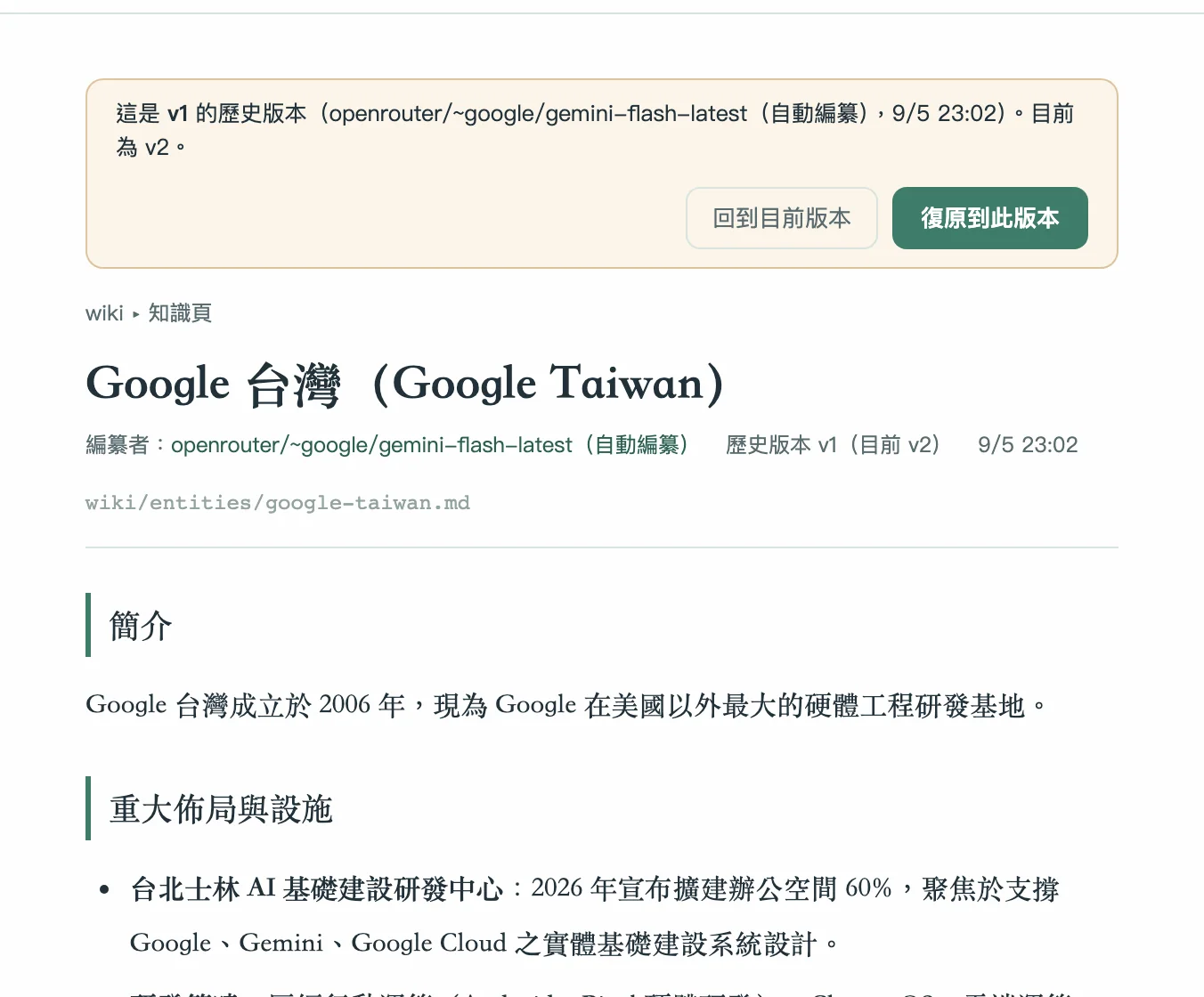
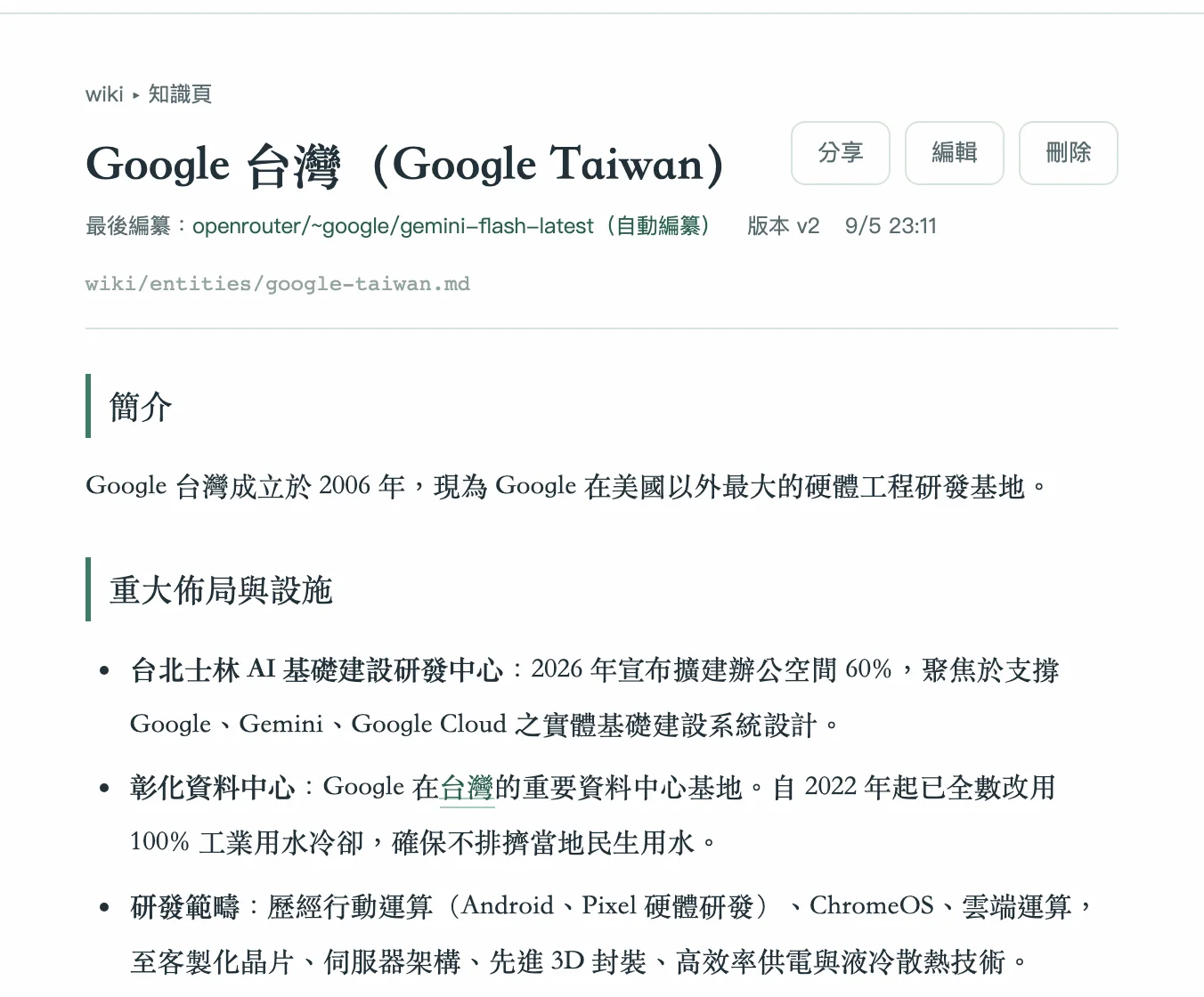
This demo wiki: 11 sources → 39 pages → 216 links. (The pair above is from our Traditional Chinese demo — what to look at is the page growing, not the words.)
Knowledge grows into a graph
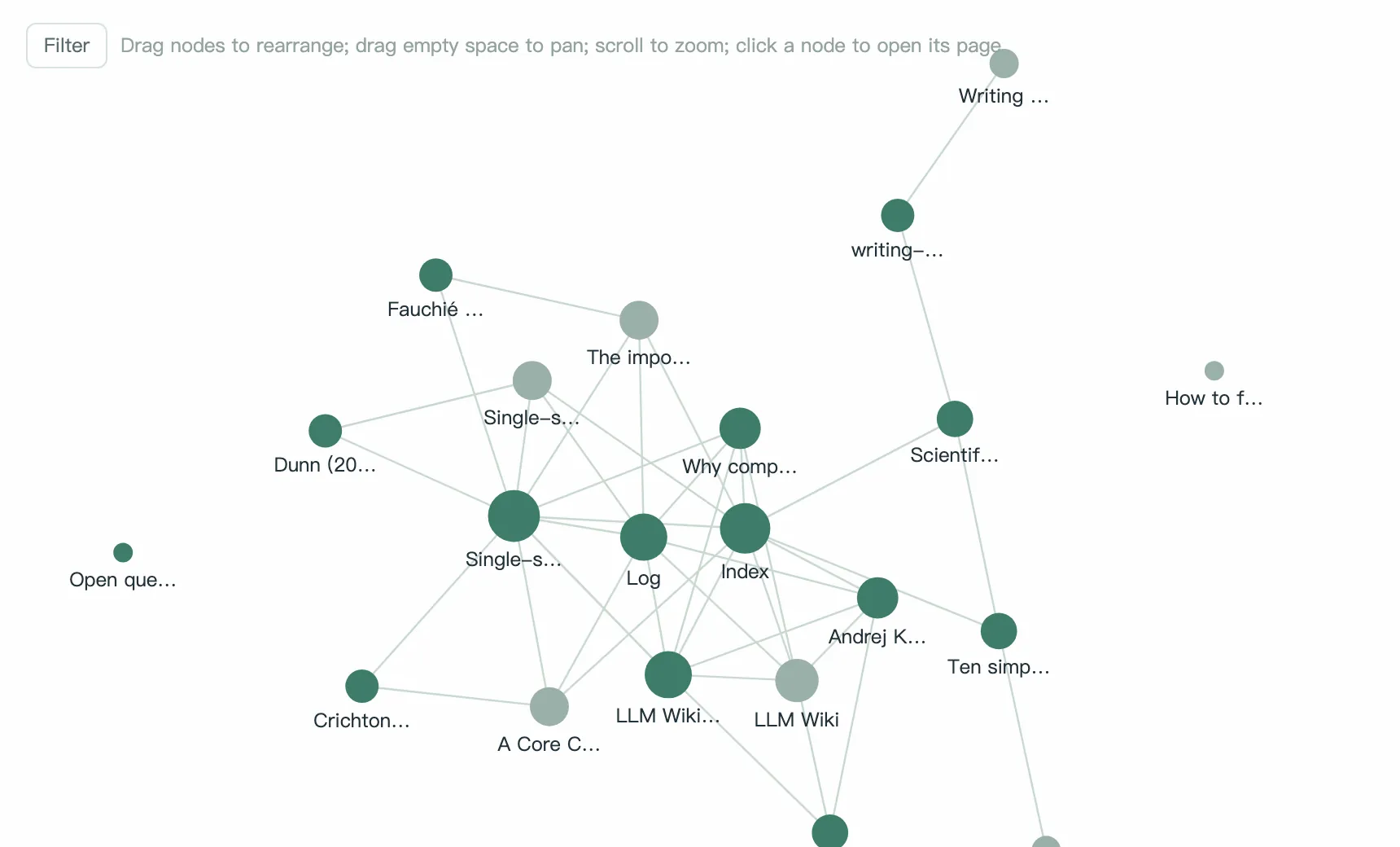
Every [[link]] and [@citation] on a page is an edge. The more sources arrive, the more obvious the hub pages become — which topics several sources already support, and which ones are still hanging off to one side. The timeline replays how the wiki grew.
Three steps, done on day one
Add a source
Paste a URL, upload a PDF or Word file, paste text, import a .bib, or connect Zotero. Sources live in raw/ and are never edited.
Let the agent compile (Ingest)
Press Compile this source; about a minute. Discuss first if you want to steer. Cursor users give the instruction in Cursor instead; the result is the same.
Ask, browse, lint
Ask (Query) and every answer names its pages; keep a good answer as a wiki page. Lint finds orphan pages, broken links and contradictions.
The agents you already use read and write this wiki
There is an MCP server built in. Cursor and Claude Code paste a token; Claude.ai and ChatGPT connect by signing in. The same six tools in every agent: read the rules, search, read, create, update, list a folder. Two agents editing the same page won’t clobber each other — the later writer gets the current version back.
{
  "mcpServers": {
    "wikibrain": {
      "url": "https://wikibrain.app/mcp",
      "headers": {
        "Authorization": "Bearer wb_live_… (generated in Settings)"
      }
    }
  }
}For researchers: citations that build their own reference list
Paste a paper’s URL or DOI and the bibliography fills itself in (Crossref, arXiv, PubMed). Write [@citekey] on a wiki page; it renders as (Author, Year), links to the source, and a reference list grows at the bottom. BibTeX and CSL-JSON in and out; a Zotero collection syncs hourly. The researcher template tells the agent to cite this way.
![A wiki page: [@fauchie2023the] in the text renders as (Fauchié, 2023) and a reference list is generated at the bottom](/landing/en/citations.webp)
Plans
- 1 knowledge base
- 200 notes
- 20 agent runs a month
- Bring your own key, or use Cursor
- Export any time
- Up to 10 knowledge bases
- Unlimited agent runs
- 10,000 notes, 1 GB
- Multiple tokens, REST API
- 90-day version history
- Cancel any time
Model usage is billed by your provider, not us: with your own API key, typical use is about US$1–3 a month. Cursor users need no key. Checkout is handled by Paddle.
Prefer to self-host? The code is open source; one docker compose command. GitHub
Open source. Your data stays yours.
The code is on GitHub under AGPL-3.0. Hosted data lives in Singapore; export the whole wiki any time as a Markdown zip that Obsidian opens, and the bibliography as .bib. The interface is in Traditional Chinese and English; write in any language.
Before you sign up
- Do I need an API key?
- Not for the first 50 runs of the trial. After that, one of three: use Cursor (no key), connect Claude.ai or ChatGPT (no key), or paste an OpenAI, Anthropic or OpenRouter key in Settings and compile from the web with one click.
- What if the agent gets it wrong?
- Every write keeps a version; restore with one click. You can also edit the page, correct it in chat, or write the rule into schema/ so it follows it next time.
- How is this different from NotebookLM?
- NotebookLM re-reads your sources every time you ask; WikiBrain compiles them into pages that stay, and Cursor and Claude can read and write them. Full comparison
- Can I take my data out?
- Any time. One click in Settings exports a Markdown zip and a .bib; you can delete the account yourself; the code is open source and self-hostable.
You drop in the sources. An agent writes the wiki.
14-day Pro trial, no card. Your first 50 agent runs need no API key.